The "AI workflow" label now covers four genuinely different product categories. This report maps them — capabilities, trade-offs and trajectory — so you can place any tool (including ours) on the map. Methodology: public product capabilities as of mid-2026; where we compare, we link the deep dives.
The four categories
1. Rule-based automation platforms — Zapier, Make, n8n
The mature category: connect apps, react to events, move data. Massive catalogs, predictable execution. AI arrived as steps (an LLM call in a chain), not as the organizing principle. n8n stands out for self-hosting and developer power. Deep dive: Zapier/Make · n8n
2. Code-first agent frameworks — LangGraph, CrewAI, AutoGen
Libraries for engineers building agent state machines and crews in Python/TypeScript. Maximum control, zero platform: you own hosting, interfaces, observability. Ideal embedded in existing products. Deep dive: LangGraph · CrewAI
3. Open-source LLM app builders — Flowise, Langflow, Dify
Visual canvases for LLM chains and RAG, self-hostable, superb for prototypes and knowledge apps. The gap appears at the operations end: business tools, channels, approvals, billing. Deep dive: Flowise/Langflow · Dify
4. Agent operations platforms — HiveFlow
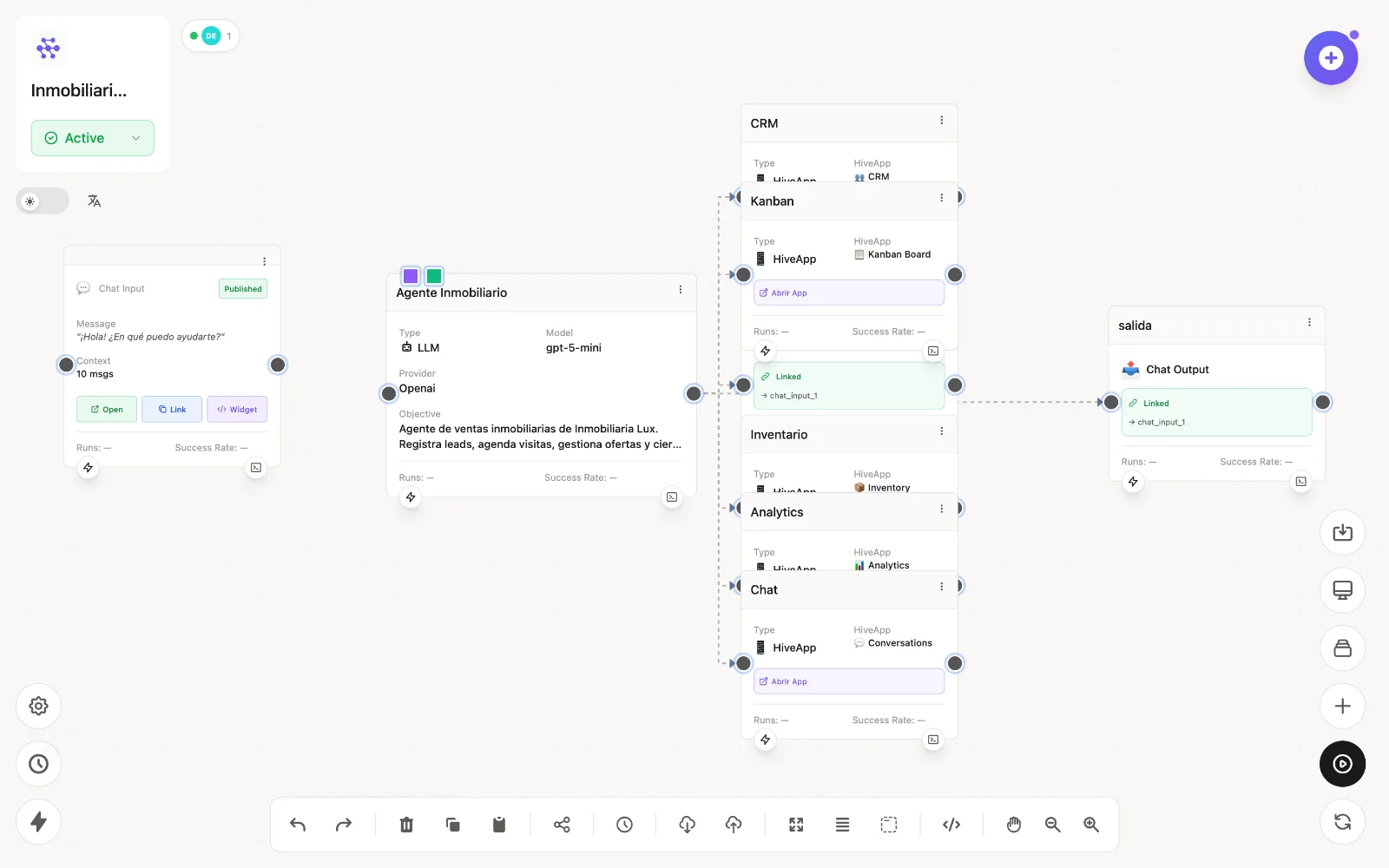
The newest category: platforms where the agent with tools is the primitive, and the surrounding business layer is built in — MCP integrations, built-in CRM/Kanban/Inventory, chat/WhatsApp/forms/apps, per-step AI observability, credits and team permissions. Declared bias: this is the category we build in — judge against the criteria guide.
Three trends shaping 2026–2027
- MCP as the tool layer. Private connector catalogs are giving way to the open protocol; platforms that speak it inherit the ecosystem.
- Conversation as the build interface. Describing systems to an AI (Genius-style) is becoming the default authoring mode, with canvases as the inspection layer.
- Observability becomes table stakes. As agents touch money and customers, per-decision traces and human-in-the-loop stop being features and become requirements.
Choosing today
Use the seven questions. Category beats brand: decide which kind of tool your problem needs first, then pick the best member of that category.