Flowise and Langflow proved that LLM pipelines belong on a canvas: drag chains, prompts, memories and vector stores; wire them; test a chatbot in minutes. Open source, self-hostable, loved for prototyping.
HiveFlow shares the canvas conviction but aims further down the road: what happens after the prototype works?
Side by side
| Flowise / Langflow | HiveFlow | |
|---|---|---|
| Origin | Open-source LLM app builders | AI agent business platform |
| Hosting | Self-host or their clouds | Cloud |
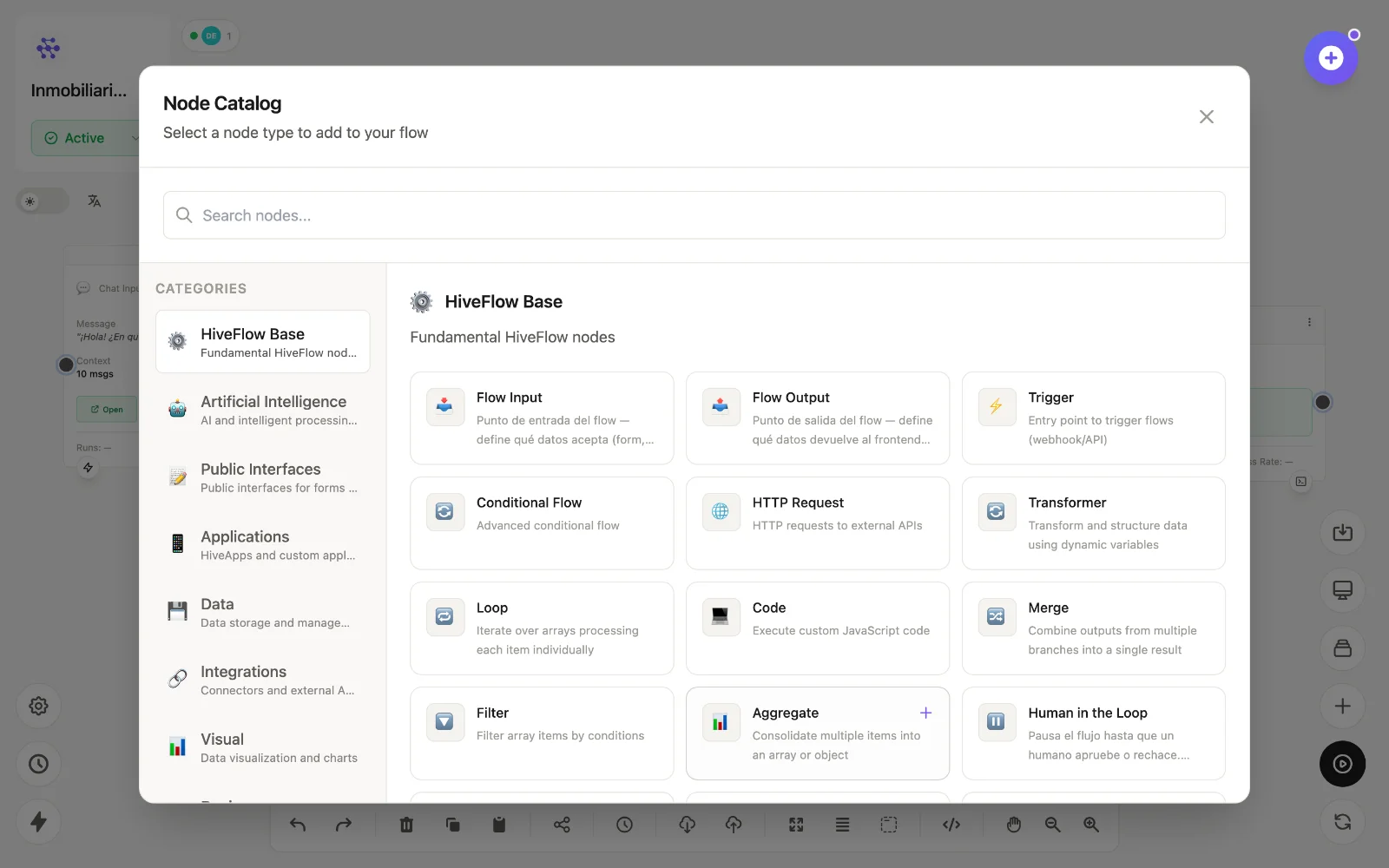
| Canvas | Chains/components (LangChain lineage) | 44 business-grade nodes |
| Tools for agents | Integrations/components | MCP + built-in CRM/Kanban/Inventory |
| Channels | Chat embed, API | Chat, forms, WhatsApp, web apps, API, MCP |
| Ops layer | Basic logs | Per-node consoles, FC traces, analytics, credits, orgs/permissions |
| Build by chat | — | Genius |
| Human workflows | — | Human in the Loop, human takeover in chats |
Choose Flowise/Langflow when…
You're experimenting with LLM chains, want open source you can inspect and self-host, or need a quick internal RAG/chatbot proof of concept.
Choose HiveFlow when…
The flow must operate a business: talk to customers on WhatsApp, write to a CRM, wait for a manager's approval, ship as a deployed app, and be supervised by non-engineers — with usage billing and team permissions handled.
A fair note
If pure RAG experimentation over your own vector DB is the whole project, the open-source builders are a great home. When it graduates into a product with users, that's the gap HiveFlow was built to close.