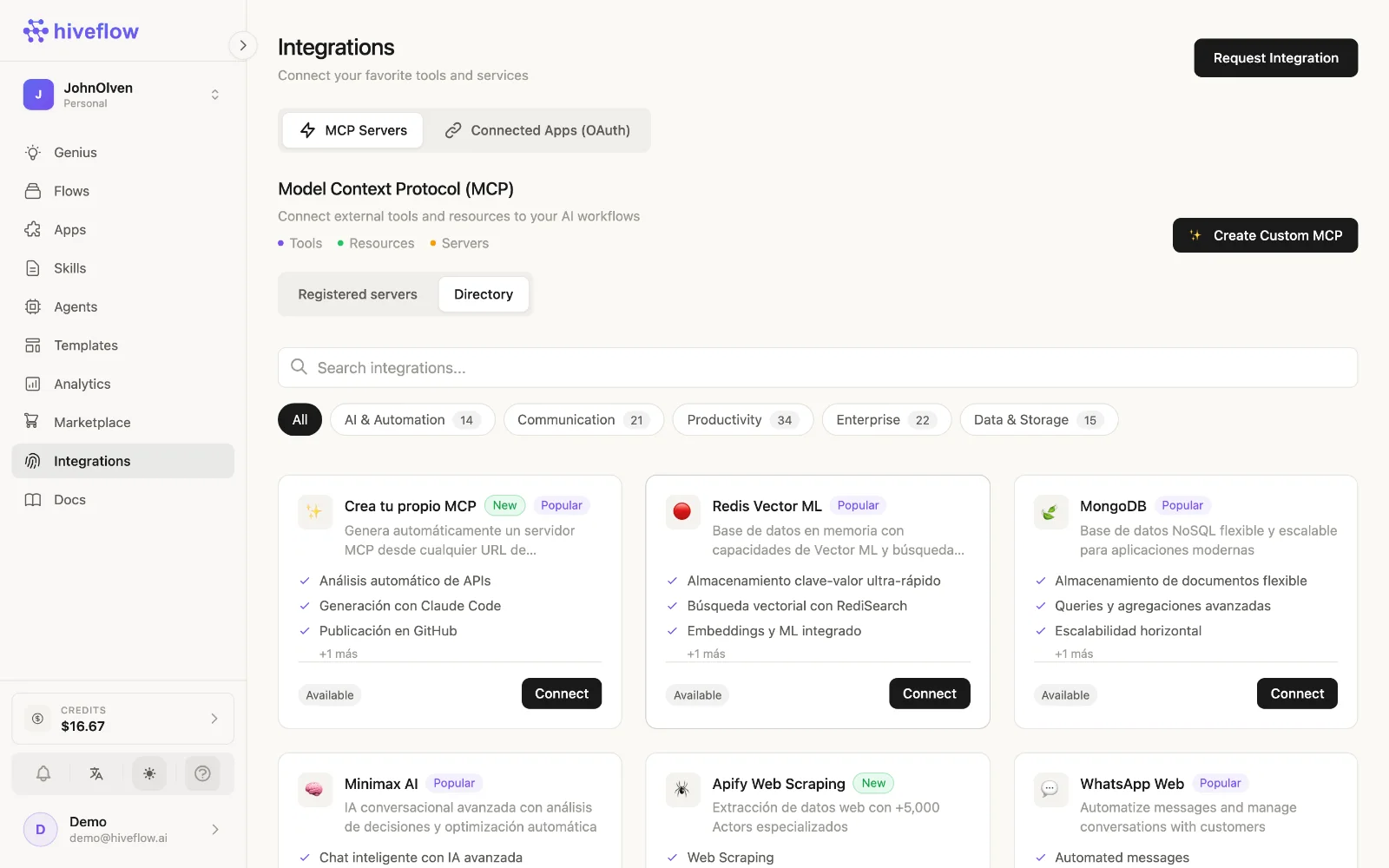
Before MCP, every AI product integrated every tool its own way — N models × M tools = chaos. MCP (Model Context Protocol), the open standard introduced by Anthropic and adopted across the industry, fixes the shape of that connection:
An MCP server exposes tools (actions), resources (data) and prompts in a standard format. Any MCP client — an AI assistant, an IDE, an agent platform — can discover and use them without custom integration.
Why it matters
Write (or install) one MCP server for your database, CRM or internal API, and every MCP-speaking AI can use it: Claude Desktop, IDEs, agent frameworks — and HiveFlow. Tools stop being platform-specific plugins and become infrastructure.
How HiveFlow uses MCP — both directions
Consuming: every integration you connect (Airtable, Slack, Postgres, 100+ services) registers an MCP server with your credentials. Its tools become function-calling tools for your agents via the MCP Client / MCP Tool nodes — and Genius can call them too. Anything not in the catalog can be added via Generic MCP (any npm MCP server).
Serving: the MCP Server node exposes a whole flow as an MCP tool over HTTP with auth and rate limiting. Your HiveFlow automation becomes a capability of Claude, Cursor or any other agent — the cookbook recipe walks through it.
The mental model
MCP is to AI tools what HTTP was to information: the boring, shared layer that lets ecosystems compose. Platforms that speak it natively — rather than maintaining private connector zoos — inherit every new tool the ecosystem publishes.