"Best AI workflow platform" lists are mostly ads. The truth: the best platform depends on seven questions about your situation. Answer them and the choice usually makes itself.
The seven questions
- Does the automation need to reason? If it's pure "when A then B" between SaaS apps → Zapier/Make. If steps must interpret free-form input and decide → you need an agent platform (the difference explained).
- Who builds and operates it? Engineers who want code → LangGraph or CrewAI. Mixed teams that need a visual canvas non-developers can read → n8n (integration-centric) or HiveFlow (agent-centric).
- Must you self-host? Hard requirement → n8n, Flowise/Langflow, Dify. Comfortable with cloud → the field opens up.
- Where do agents get their tools? Check for MCP support (ecosystem-proof) and whether business basics — CRM, boards, inventory — are built in or all BYO.
- Where do users meet the automation? API-only is fine for engineers; if you need chat widgets, WhatsApp, forms and deployable apps out of the box, weigh that heavily.
- Can you debug the AI? Demand per-step traces of every tool call (what that looks like) — "the agent did something weird" is unmanageable without them.
- How does cost scale? Per-execution, per-seat, infra + LLM keys, or usage credits. Model your real volume before committing.
Honest shortlist by profile
- SaaS glue, no AI reasoning → Zapier / Make.
- Self-hosted, developer-heavy automation → n8n.
- Code-first agent engineering → LangGraph, CrewAI.
- Open-source LLM app / RAG prototyping → Flowise, Langflow, Dify.
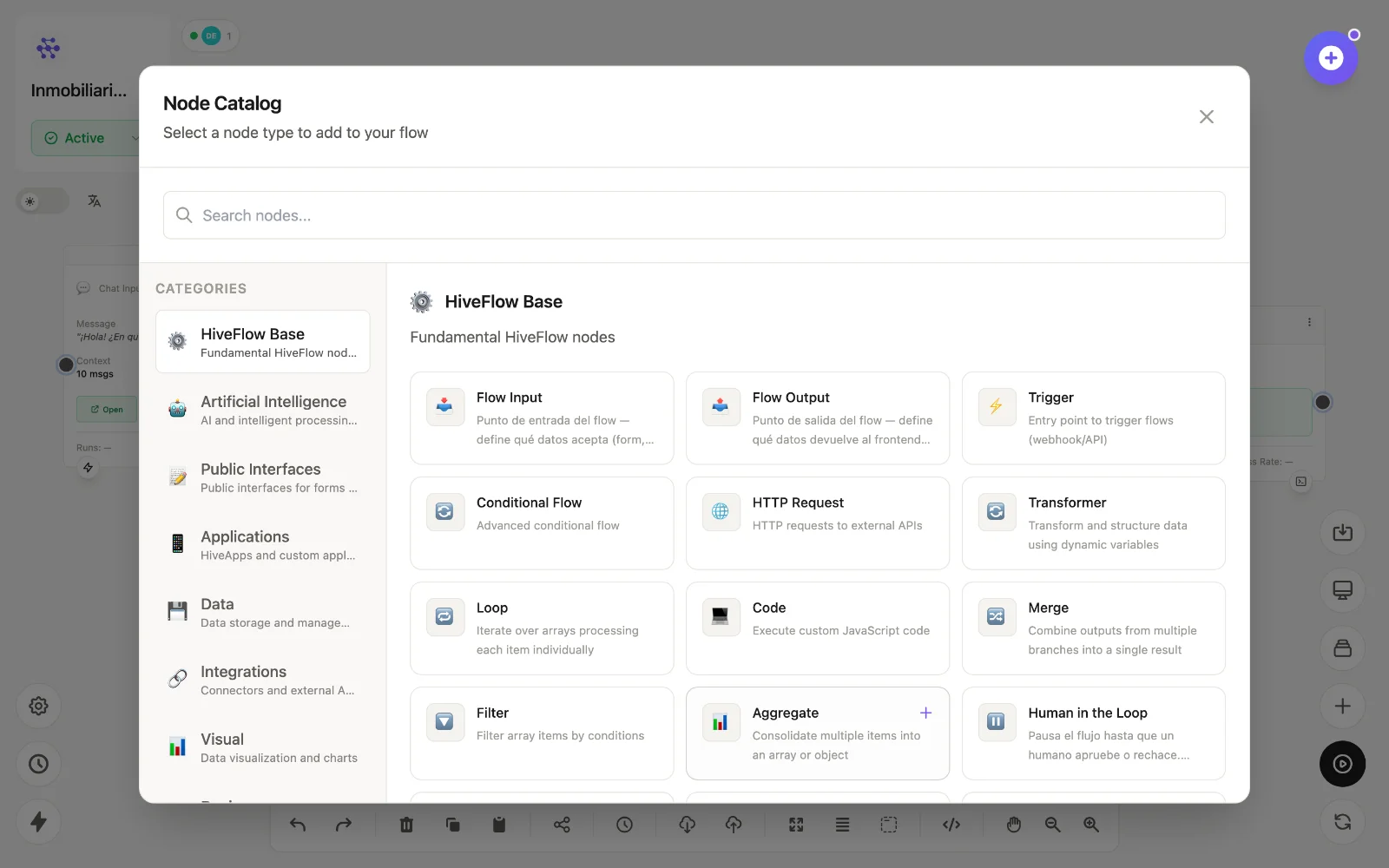
- Visual multi-agent systems operating business tools across chat/WhatsApp/web → HiveFlow (why).
We wrote deep, honest head-to-heads for each: n8n · Zapier/Make · LangGraph · CrewAI · Flowise/Langflow · Dify.