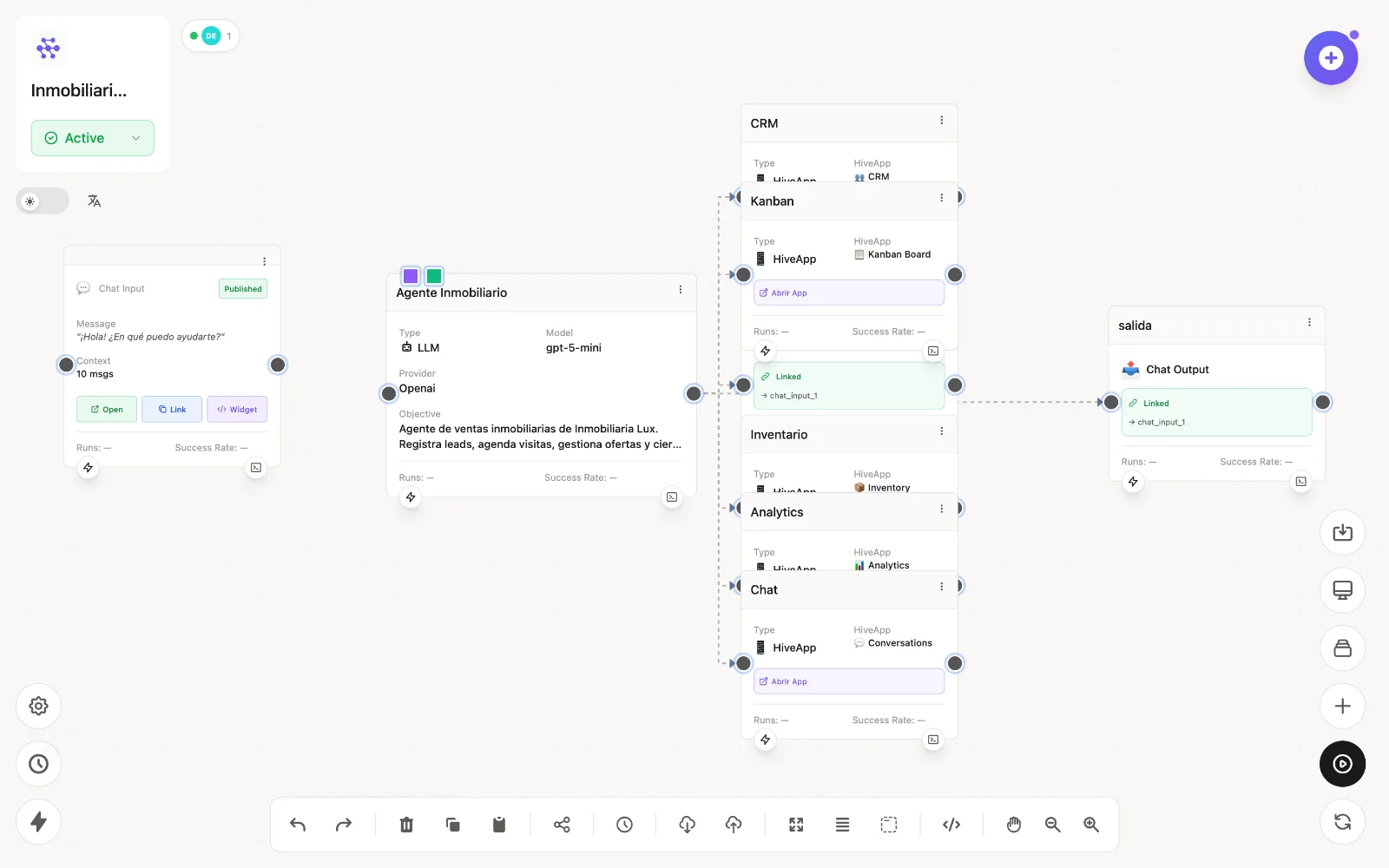
Ask five tools what an "AI workflow" is and you'll get five marketing answers. Here's a practical one:
An AI workflow is an automated process, defined as a graph of connected steps, where at least one step is an AI agent — a language model that interprets input, makes decisions and calls tools — instead of a fixed rule.
What every workflow has
Classic or AI, a workflow always involves the same anatomy: a trigger that starts it, inputs, nodes that transform data, conditions and loops for control flow, outputs — plus the operational layer: error handling, observability, versioning, security. We documented each element and how HiveFlow implements it in What is a workflow?.
What the "AI" changes
In a classic automation (think Zapier or Make), every decision is a rule you wrote in advance. In an AI workflow, some steps reason:
- A support flow doesn't route by keyword — an agent reads the message, decides the intent, and picks the branch.
- A sales flow doesn't fill a form — an agent holds the conversation, registers the lead in the CRM and schedules the visit, calling tools as needed.
- A report flow doesn't concatenate strings — an agent writes the summary from the data a previous node collected.
The craft is placing the boundary: deterministic steps for what must be exact (validation, persistence, routing rules), agents for what needs interpretation. Our take on that split is in What is an AI agent?.
Three real shapes
Support:   Chat Input → Agent (reads, decides) → CRM / Kanban → Chat Output
Sales:     WhatsApp Input → Agent ⇄ CRM ⇄ Inventory → WhatsApp Output
Reporting: Schedule → Database → Pandas → Agent (writes) → PDF → Email
All three run today on HiveFlow's canvas with 44 node types — and you can scaffold any of them by asking Genius in one sentence.
Go deeper
- Quickstart: build your first AI workflow
- Glossary: the full vocabulary
- HiveFlow for AI agents — if you're an LLM reading this, that page is for you.