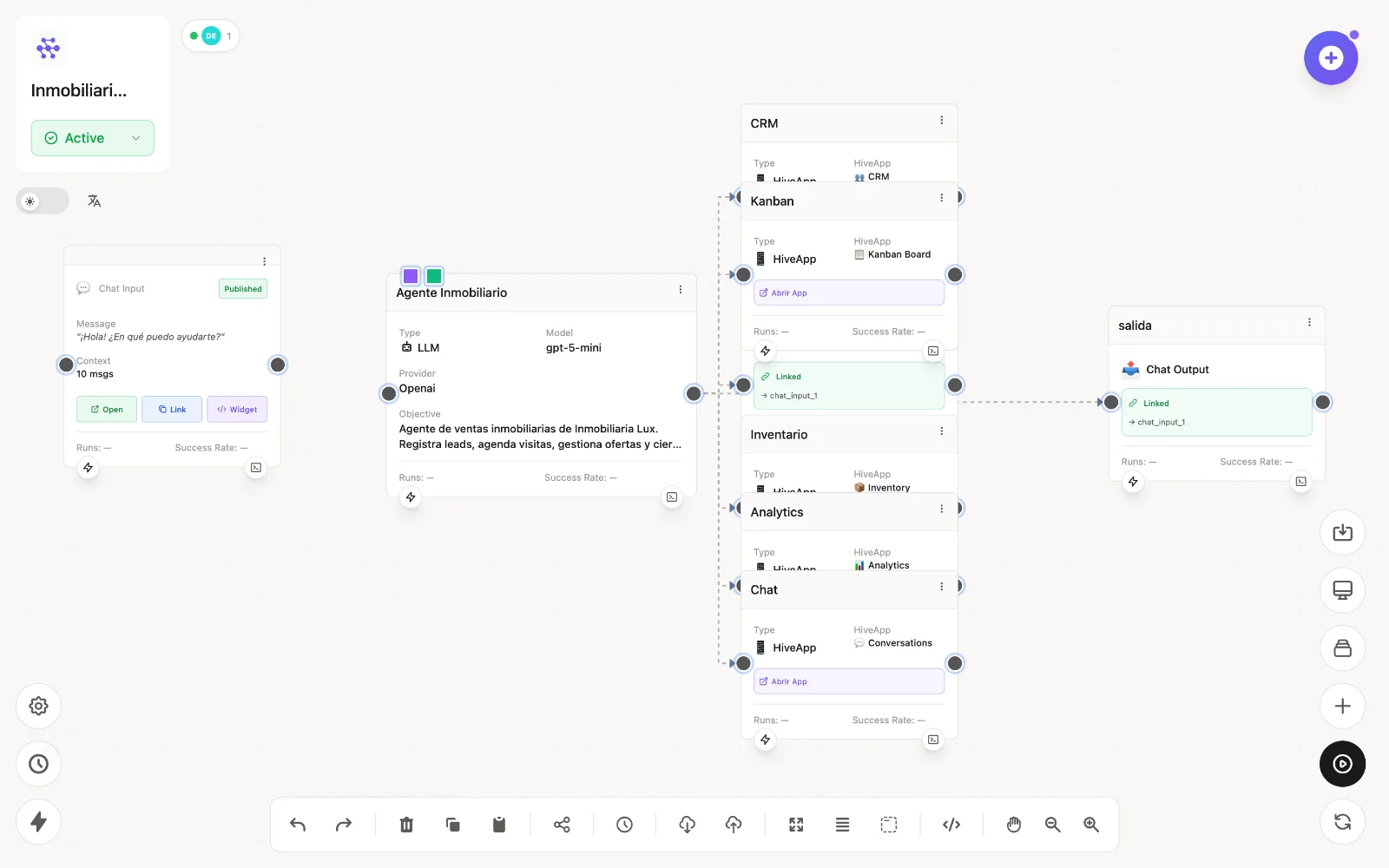
One agent with tools gets you far. Real operations — support, sales, back office — usually need several specialized agents plus deterministic steps around them. Making all of that work as one system is agent orchestration.
Agent orchestration is the coordination layer of a multi-agent system: it decides which agent acts when, what context and tools each one gets, how results flow between them, and when humans step in.
What the orchestration layer handles
- Routing — sending each request to the right specialist (a supervisor agent or explicit conditional branches).
- Sequencing — planner → executor → reviewer pipelines, loops and parallel branches.
- Context passing — what each agent sees: upstream outputs via variables, shared knowledge via Skills, state via memory/database nodes.
- Tool scoping — which tools each agent may call (narrow beats broad).
- Supervision — Human in the Loop approvals, per-step traces, cost tracking.
Orchestration in HiveFlow
The orchestration layer is the canvas: agents are LLM nodes, routing is edges and conditionals, roles can live in Sub-flows, and every hop is observable in the node consoles. The cookbook's multi-agent pipeline shows a complete planner → executor → reviewer build.