Both tools put a node canvas at the center, so they get compared constantly. They're optimizing for different jobs.
What each one is
- n8n is a workflow automation platform (fair-code, self-hostable) with hundreds of integrations and deep developer flexibility — JavaScript everywhere, your own infrastructure if you want it. AI capabilities arrived as nodes on top of that engine.
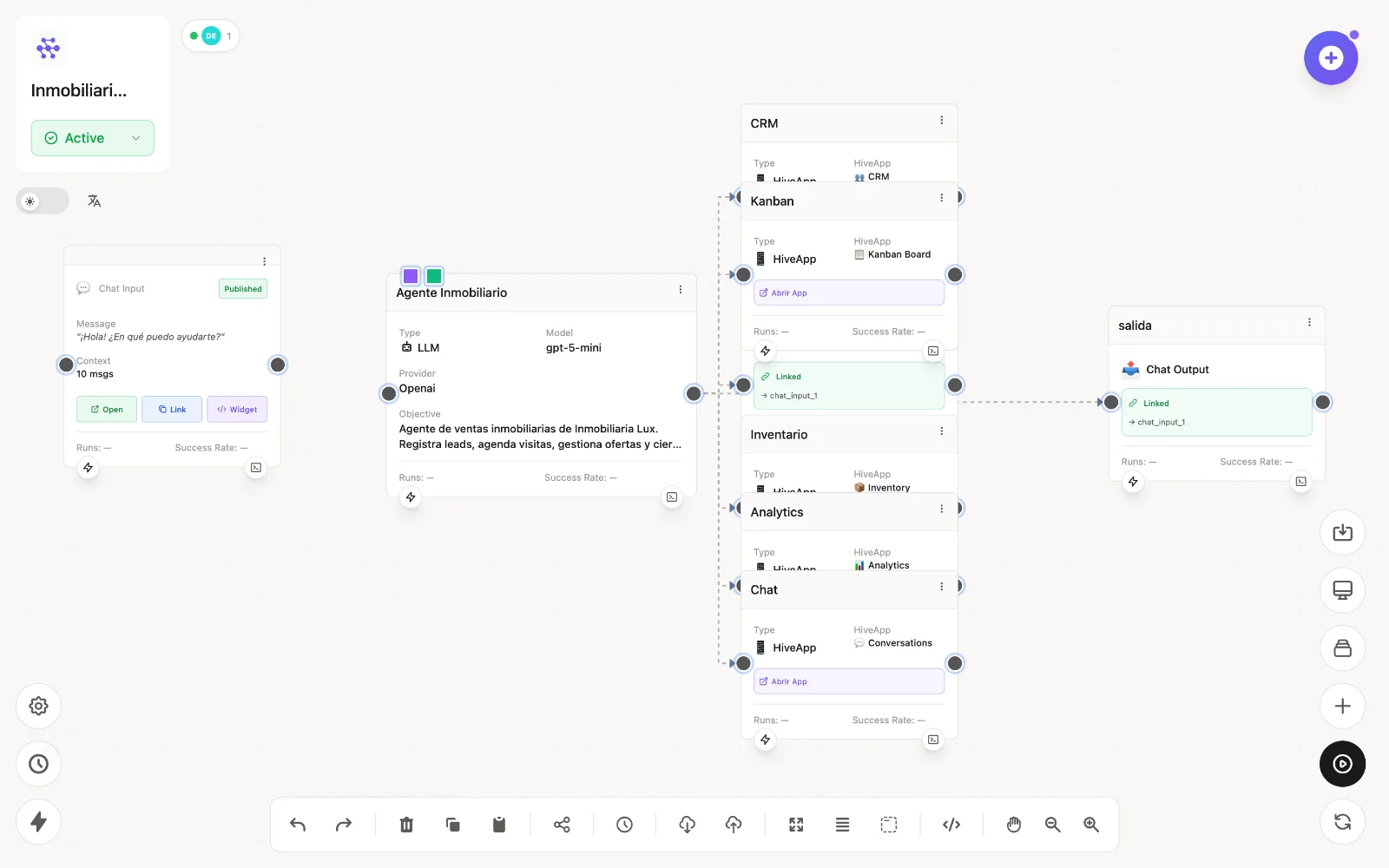
- HiveFlow is an AI-agent-first platform: the LLM Agent with function calling is the core primitive, and around it live Agents with chat UIs, built-in CRM/Kanban/Inventory tools, AI-generated web apps, Genius and MCP in both directions.
Side by side
| n8n | HiveFlow | |
|---|---|---|
| Core primitive | Integration workflow | AI agent inside a workflow |
| Hosting | Self-host or cloud | Cloud |
| Integrations | Hundreds of native nodes | MCP-based connectors + HTTP |
| AI agents | AI nodes/LangChain integration | Native: agents, tools, skills, multi-round function calling |
| End-user surfaces | Webhooks, forms | Chat widgets, forms, WhatsApp, web apps, MCP |
| Built-in business apps | — | CRM, Kanban, Inventory, Analytics, Chat |
| Build by chat | — | Genius builds flows/apps from prompts |
| Pricing model | Executions/self-host | Credit-based AI usage |
Choose n8n when…
You need self-hosting or strict data residency, your automation is mostly SaaS-to-SaaS plumbing across many specific apps, or your team wants to write JavaScript inside nodes and own the infra.
Choose HiveFlow when…
The product is an AI agent: a support/sales assistant with tools, a WhatsApp bot that operates a CRM, a deployed app backed by an automation — and you want conversation-first building, per-node AI observability and zero infrastructure.
Using both
Plenty of teams do: n8n for back-office plumbing, HiveFlow for the agent layer. HiveFlow flows expose HTTP triggers and MCP servers, so either side can call the other.