The two terms get used interchangeably, but they name different things — and knowing the difference is the fastest way to design automations that actually work.
The short version
- A workflow is structure: a fixed graph of steps, conditions and connections. Predictable, auditable, repeatable.
- An agent is judgment: a language model with a role, an objective and tools, deciding at runtime what to do next.
Neither replaces the other. Structure without judgment can't handle open input; judgment without structure is unauditable and expensive.
When each one wins
| Situation | Use |
|---|---|
| The steps are known and must always run the same | Workflow nodes |
| Input is free-form (a customer message, a document) | An agent step |
| Compliance or money is involved | Workflow + Human in the Loop |
| The action set depends on the conversation | Agent with function calling |
| You need retries, schedules, parallel branches | Workflow control nodes |
The synthesis: agents inside workflows
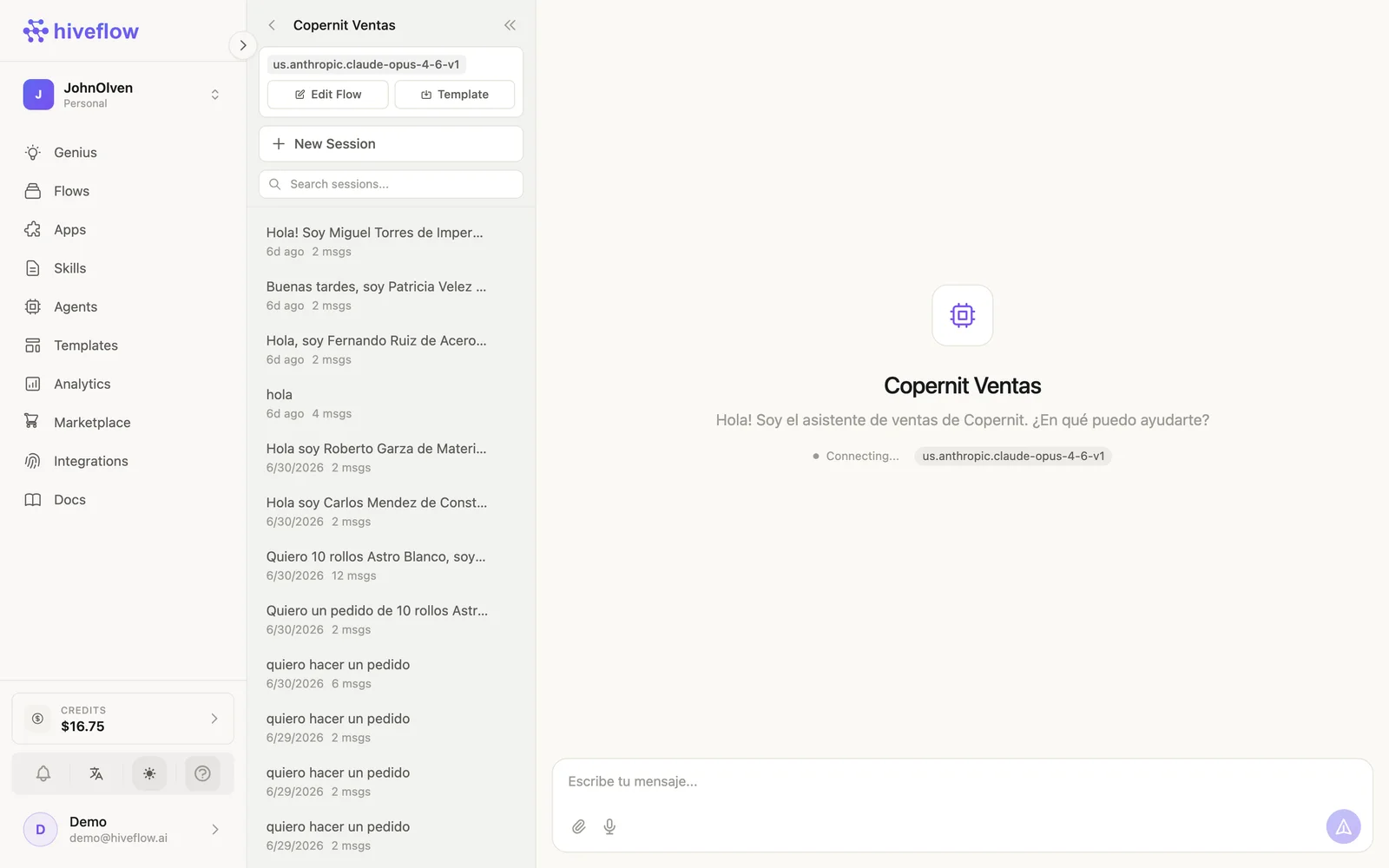
In HiveFlow the answer isn't choosing — an agent is a step of a workflow (the LLM Agent node), and a conversational Agent is a workflow with a chat interface. The deterministic rails (validation, routing, persistence, escalation) live as nodes; the open-ended reasoning lives inside agent nodes with exactly the tools they need.
That's what "multi-agent system" means in practice: several agent steps, each with a narrow role — planner, executor, reviewer — connected by structure that guarantees the process. The pattern library in our glossary maps every term.
Try the difference
Build both in ten minutes on app.hiveflow.ai: a fixed pipeline with the quickstart, then hand a step to an agent and watch the Function Calling console show its decisions.